
.svg)
.svg)
.svg)


.svg)


.svg)
.svg)

.svg)

Key Takeaways
- A data engineering company builds the pipelines, warehouses, and governance systems that turn scattered business data into trustworthy insights.
- Data engineering services combine strategy, integration, and quality checks so analytics and AI tools work with accurate, reliable information daily.
- Big data engineering handles massive volumes through batch and streaming pipelines, letting businesses process information without delays or bottlenecks.
- Strong data infrastructure and automated data pipelines reduce manual work, cut costly errors, and help businesses scale confidently as data grows.
A retail chain tracks orders in Shopify, customer chats in Zendesk, and inventory in a separate warehouse system. None of these three systems talk to each other. The finance team pulls one number, marketing pulls another, and nobody trusts either report by Friday. This is the exact issue that data engineering companies aim to resolve.
They take scattered, messy, fast-growing business data and turn it into something people can actually use. Gartner estimates poor data quality costs the average organization $12.9 million every year, and that number keeps rising as businesses collect more information from more sources. Data engineering companies build the pipelines, warehouses, and governance systems that stop this bleeding. This guide explains what these companies do, the technologies they use, and how to choose the right one for your business.
What Are Data Engineering Companies?
Data engineering companies are firms that design, build, and maintain the infrastructure businesses need to collect, store, and process data at scale. A data engineering company doesn't analyze data or build dashboards directly. Instead, it builds the pipes, warehouses, and workflows that make analytics and AI possible in the first place.
Think of a data engineering company as a plumber for information. Data flows in from apps, sensors, databases, and third-party tools, and the company builds the systems that carry it cleanly to where it's needed. Without this foundation, business intelligence teams and data scientists spend most of their time cleaning data instead of using it. Data engineering companies exist precisely to remove that bottleneck so decision-makers get accurate numbers on time every time.
What Core Services Do Data Engineering Companies Provide?
The five main services that data engineering companies provide are usually strategy and architecture, pipeline development, integration (ETL or ELT), warehouse and lake implementation, and ongoing data governance. These services are components of an interconnected system, not individual products. Most data engineering companies offer these as packages based on company size and data maturity. When getting started, a business rarely needs all five at once.
Data Strategy and Architecture Design
A data engineering company will map out how the data needs to flow through a business before they even write a line of code. This includes choosing a cloud platform, designing system connectivity, and scaling architecture as the data volume increases. Bad design choices made early on generally cost much more to fix later than to get right the first time.
Data Pipeline Development and Automation
A data pipeline is an automated path for data to take from a source to a destination, such as a warehouse or dashboard. Data engineering companies create these pipelines so that data flows between them without manual copy-pasting or spreadsheet exports. Automation directly reduces human error and frees up analysts' time for analysis.
Data Integration and ETL/ELT Services
It means taking data from many different systems and consolidating it into one central point. Extract, transform, load, clean, and reshape ETL data before it lands in storage. ELT extracts and loads raw data first and then transforms it within the warehouse. These days, modern data engineering services are leaning toward ELT, as cloud warehouses have the ability to perform transformation at scale.
Data Warehouse and Data Lake Implementation
A data warehouse is a repository of structured and organized data that is ready for reporting and analysis. A data lake is a storage repository that holds a vast amount of raw data in its native format until users need it. A data lakehouse is a hybrid of the two, offering businesses the flexibility of a lake with the structure and governance of a warehouse.
Data Quality, Governance, and Observability
Data governance establishes the rules for who can access data and how to use it. Data quality practices catch errors, duplicates, and inconsistencies before they reach decision-makers. Data observability continuously monitors pipelines, alerting teams the moment something breaks or looks abnormal, before it turns into a bigger problem.
How Do Data Engineering Companies Build Data Pipelines?
Data engineering companies build pipelines in five stages: collecting data from source systems, ingesting it as batch or streaming data, transforming it into a usable format, orchestrating the whole workflow automatically, and monitoring it for failures. Each stage depends on the one before it, and a weak link anywhere in the chain can quietly corrupt everything downstream.
Collecting Data From Business Sources
Data comes from many places at once, including internal databases, third-party APIs, customer applications, and IoT sensors. Data engineering companies first identify every relevant source and confirm each one is reliable and accessible before building around it.
Ingesting Batch and Streaming Data
Batch processing collects and moves data in scheduled chunks, such as once every hour or once a day. Stream processing moves data continuously and in real time, which matters for use cases like fraud detection or live dashboards. Apache Kafka is one of the most widely used tools for handling streaming data at scale, and most companies specializing in enterprise data engineering have deep expertise with it.
Transforming Raw Data Into Usable Data
Raw data is rarely ready to use as-is. It needs cleaning, formatting, deduplication, and standardization before anyone downstream can trust it. Tools like dbt have become the standard here because they let teams transform data using plain SQL, which most analysts already know how to write.
Orchestrating Automated Data Workflows
Workflow orchestration schedules and sequences every step in a pipeline so nothing runs out of order or gets skipped. Apache Airflow is the most common orchestration tool in this space, coordinating jobs across APIs, databases, and warehouses on a defined schedule.
Monitoring Pipeline Performance and Failures
Even well-built pipelines break, whether from an API change, a schema shift, or a server outage. Data engineering companies set up monitoring and alerting so they catch failures within minutes, not weeks later when a report looks obviously wrong.
What Technologies Do Data Engineering Companies Use?
Data engineering companies rely on cloud platforms, warehouses, processing frameworks, and programming languages that together handle everything from raw storage to complex transformations. The exact stack varies by company size and industry, but a few tools show up almost everywhere.
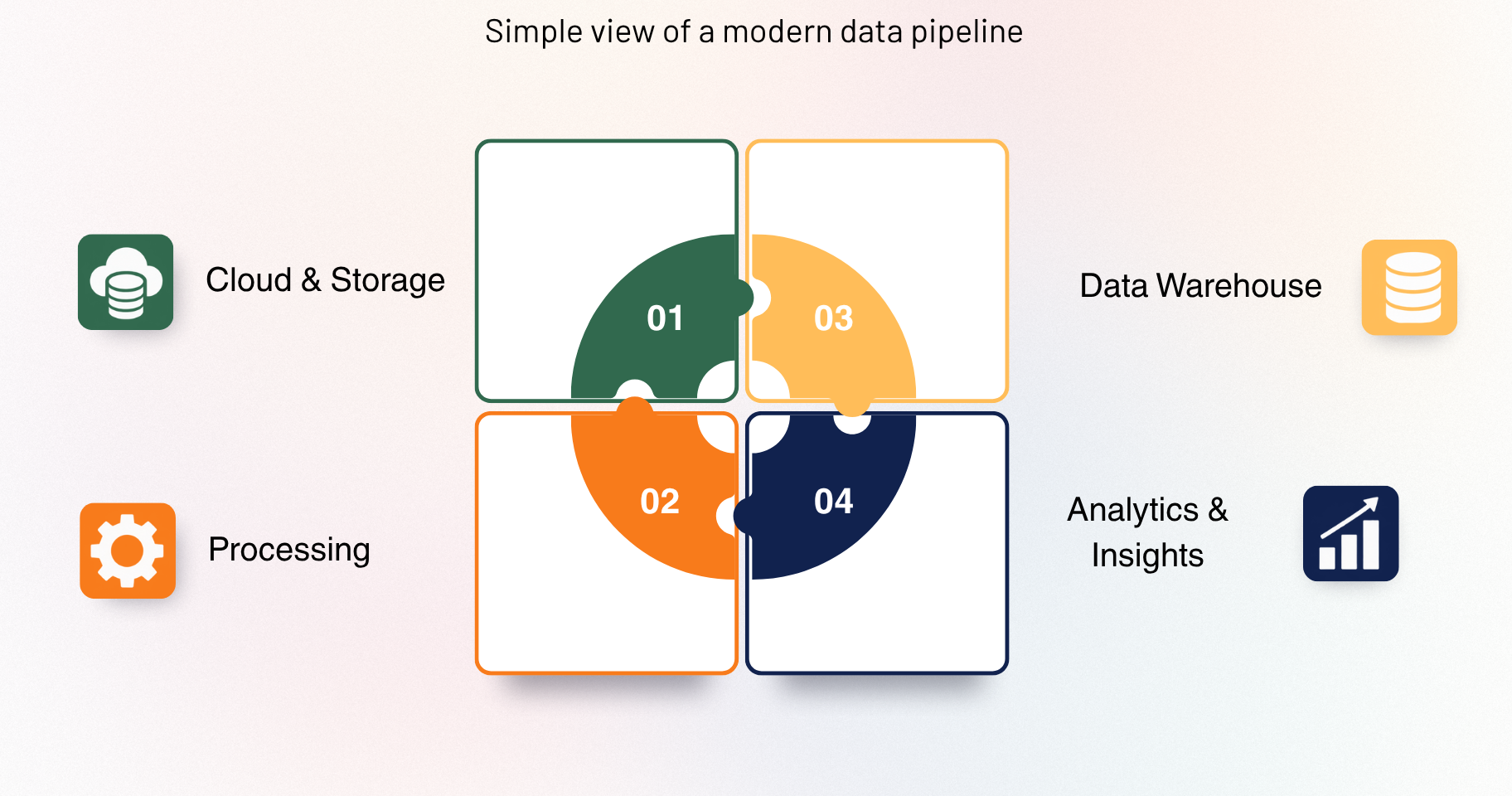
Quick Notes:
- AWS, Microsoft Azure, and Google Cloud provide the underlying infrastructure most data engineering companies build on top of
- Snowflake and Databricks have become the dominant warehouse and lakehouse platforms
- Both separate storage from compute, which keeps costs predictable as data grows
- Apache Spark handles large-scale data processing across distributed clusters
- Python and SQL remain the two languages nearly every data engineer uses daily
- Scala shows up mostly in Spark-heavy environments that need extra performance
- A data engineering company's technology choices should always match the client's existing systems rather than forcing a rebuild from scratch
How Data Engineering Amplifies the Business Value of Advanced Analytics
Data engineering turns raw, scattered information into a single reliable foundation that analytics, AI, and business intelligence tools can actually build on. Without this foundation, even the best analytics software produces unreliable results. McKinsey research found data-driven organizations are 23 times more likely to acquire customers and 19 times more likely to be profitable than their peers.
Creating Reliable Single Sources of Truth: When every department pulls numbers from the same clean warehouse, arguments about whose report is correct disappear. This single source of truth is often the single biggest value driver data engineering companies deliver.
Enabling Faster Analytics and Reporting: Clean, automated pipelines mean dashboards update on their own instead of requiring manual refreshes. Teams get answers in minutes instead of waiting days for an analyst to pull and clean the data manually.
Supporting Artificial Intelligence and Machine Learning: AI and machine learning models are only as good as the data feeding them. Gartner found 73% of enterprise data leaders rank data quality as the biggest barrier to AI success, ahead of model accuracy or compute cost.
Scaling Data Operations as Businesses Grow: A pipeline built for ten thousand records a day often collapses under ten million. Data engineering companies design for scalability from the start, so growth doesn't force a costly system rebuild later.
Reducing Manual Data Management Costs: Every hour an employee spends manually fixing spreadsheets is an hour not spent on higher-value work. Automated, well-governed pipelines cut this manual burden significantly and free up skilled staff for actual analysis.
What Problems Do Data Engineering Companies Solve?
Data engineering companies solve data silos, unreliable pipelines, scaling limits, inconsistent data, and weak security or compliance practices. These five problems tend to compound each other, so businesses often notice all of them at once rather than one at a time.
Eliminating Data Silos Across Departments: Data silos happen when sales, marketing, and finance each keep their own separate, disconnected records. Data engineering companies connect these systems into one shared environment where everyone works from the same numbers.
Fixing Slow or Unreliable Data Pipelines: A pipeline that breaks weekly or takes hours to run isn't just annoying; it actively delays decisions. Data engineering companies rebuild these pipelines to run faster, fail less, and recover automatically when something does go wrong.
Handling Growing Data Volumes: As businesses add tools, customers, and transactions, data volume grows fast, often faster than infrastructure was built to handle. Data engineering companies design systems with headroom, so a busy sales quarter doesn't crash the reporting stack.
Improving Data Accuracy and Consistency: Data consistency means the same customer record looks identical no matter which system pulls it up. Master data management, or MDM, is the practice data engineering companies use to keep one consistent version of key records across every system.
Strengthening Security, Privacy, and Compliance: Data security and data privacy aren't optional extras; they're legal requirements under regulations like GDPR and CCPA. Data engineering companies build access controls, encryption, and data lineage tracking so businesses can prove exactly where their data came from and who touched it.
Which Industries Use Data Engineering Services?
Financial services, healthcare, retail, manufacturing, and SaaS companies are the heaviest users of data engineering services today, though nearly every data-heavy industry now needs some version of this support.
Financial services and fintech: Banks and fintech firms need real-time fraud detection, accurate risk models, and strict regulatory reporting, all of which depend on clean, well-governed data pipelines.
Healthcare and Life Sciences: Hospitals and life sciences companies deal with sensitive patient data across dozens of disconnected systems, making secure, compliant data integration a constant priority.
Retail and Ecommerce: Retailers track inventory, customer behavior, and sales across online and physical stores, and data engineering companies stitch these sources together for accurate demand forecasting.
Manufacturing and Supply Chain: Manufacturers pull data from IoT sensors, production lines, and logistics partners, using data pipelines to catch supply chain delays before they become expensive problems.
SaaS, Media, and Technology: SaaS and tech companies generate massive product usage data and need it processed quickly to guide product decisions and reduce customer churn.
How Should Businesses Choose Data Engineering Companies?
Businesses should evaluate data engineering companies on technical expertise, industry experience, team structure, security practices, and long-term cost. Skipping any one of these often leads to a mismatched partnership down the line.
- Assessing Technical Expertise and Cloud Experience: Ask which cloud platforms and tools the company specializes in, and confirm that expertise matches your existing systems rather than requiring a full migration.
- Evaluating Industry Knowledge and Case Studies: A data engineering company that has already solved your industry's specific compliance and data challenges will move faster and make fewer costly mistakes.
- Understanding Team Structure and Engagement Models: Some data engineering companies offer dedicated teams; others work project by project. Match the engagement model to how ongoing your data needs actually are.
- Checking Security, Governance, and Compliance Practices: Ask directly how the company handles encryption, access control, and compliance with regulations like GDPR or CCPA before signing anything.
- Comparing Costs, Scalability, and Long-Term Support: The cheapest option upfront isn't always the cheapest option over three years, especially if the architecture can't scale without a costly rebuild.
Conclusion
Data engineering companies build the invisible infrastructure that makes every dashboard, AI model, and business decision trustworthy. From pipelines to governance, their work determines whether a business's data is an asset or a liability. As data volumes keep growing, choosing the right data engineering company matters more than ever for staying competitive.
Ready to build a data infrastructure that actually works for your business? Contact Geopit today to talk through your data challenges and find the right approach for your team.
FAQ
1. What do data engineering companies do?
Data engineering companies design, build, and maintain the pipelines, warehouses, and governance systems that turn raw business data into clean, reliable, analytics-ready information.
2. How can businesses measure the ROI of data engineering services?
Track metrics like reduced manual reporting hours, faster time-to-insight, fewer pipeline failures, and improved data accuracy across departments before and after implementation.
3. What is the difference between data engineering and data science?
Data engineering builds the infrastructure and pipelines that move and store data, while data science analyzes that data to find patterns, build models, and generate insights.
4. How can data engineering reduce operational costs and inefficiencies?
By automating manual data cleaning and reporting tasks, data engineering frees up staff time and prevents costly errors caused by inconsistent or outdated information.
5. How do businesses choose the right data engineering company?
Compare technical expertise, industry experience, engagement model, security practices, and long-term scalability rather than choosing based on price alone.
Thirunavukkarasu RM
.svg)
.svg)

.avif)





.svg)


.svg)