
.svg)
.svg)
.svg)


.svg)


.svg)
.svg)

.svg)

Summary
- Outsourcing database maintenance frees your internal IT staff to build core products instead of firefighting routine tasks.
- Proactive monitoring catches performance issues early, saving your business from expensive outages and emergency repair fees.
- Verify that support is handled by certified database administrators rather than general help-desk staff during critical outages.
- Protect your data through strict compliance standards, clear contractual response times, and strong access controls.
It's 2 AM on a Friday when a retail company's checkout database locks up during a flash sale. This is precisely when the true value of a DBA managed services provider becomes clear. Orders stop processing, support tickets pile up, and by the time someone reaches a qualified engineer, the business has lost nearly an hour of peak sales. This kind of situation happens more often than most IT leaders want to admit. It is often when a company realizes its support setup cannot handle a real database emergency.
This is exactly why choosing the right DBA managed services provider has become a strategic decision, not a back-office task. Most enterprises today run PostgreSQL, MySQL, Oracle, SQL Server, and MongoDB side by side. They use on-premise systems and multiple clouds. General IT teams often lack the depth to spot issues early. Those issues can grow into outages.
This blog breaks down twelve questions worth asking any DBA Managed Services Provider before signing a contract.
What Are DBA Managed Services?
DBA (Database Administrator) managed services mean hiring an outside expert team. They handle database maintenance, monitoring, and fine-tuning. These providers handle daily tasks like backups, security updates, performance tuning, and 24/7 issue fixes. This lets in-house IT teams focus on core business growth.
The 12 Questions Every IT Leader Should Ask a DBA Managed Services Provider
When vetting a DBA Managed Services Provider, IT leaders must look beyond general IT support. They should focus on database performance, emergency response, security, and staffing models. This helps protect critical corporate assets.
Q1: Which database engines do you specialize in?
Not every provider that claims to be a "database expert" actually has depth across engines. A team strong in SQL Server may lack deep PostgreSQL knowledge, and a MongoDB specialist may never use Oracle RAC. Ask for the exact list of engines they support in production, not just those on their website. Ask how many active client environments run on each engine today.
Q2: How many years of hands-on DBA experience does your team have, and how do you verify that experience?
Titles like "senior DBA" get used flexibly, so the answer needs to go beyond a resume claim.
- Ask for years of production experience per engine, not combined general IT experience
- Ask for relevant certifications such as Oracle OCP, Microsoft Certified: Azure Database Administrator Associate, or MongoDB Professional
- Ask if you can speak directly with the DBA who would be assigned to your account before signing
- Ask for case studies or references tied to environments similar in scale to yours
Q3: Will your in-house team handle our database work, or will you subcontract any part of it?
This question catches a gap many providers would rather not highlight upfront.
- Specific numbers on downtime reduction, query performance improvement, or infrastructure cost savings
- A migration or tuning project with a timeline that was actually met, not just promised
- A reference client willing to speak directly about results, not just a quote on a website
- Vague answers that lean only on testimonials without any data behind them are worth treating as a red flag
Q4: What incident response SLA do you guarantee for each severity level? Is it documented in the contract?
Response time and resolution time are two different things, and both need numbers attached.
- Get the exact response time commitment for P1, P2, and P3 incidents in writing
- Get separate resolution time targets, since a fast response with a slow fix doesn't help during an outage
- Confirm these figures appear in the contract itself, not just in a sales conversation
Q5: Is your 24/7 support staffed by certified DBAs at all times, or do requests go through a general help desk first?”
- Ask who physically answers a P1 call at 3 AM on a weekend
- Ask if that person is a database administrator or a first-line support agent who escalates after triage
- Ask about the on-call rotation and how many DBAs are covering it at any given time
- Ask how quickly a call gets escalated to a senior engineer if the first responder can't resolve it
Q6: What happens contractually when an SLA commitment is missed?
- Ask whether missed SLAs trigger service credits and how those are calculated
- Ask how missed SLAs are tracked and reported, ideally through monthly or quarterly reviews
- Ask for an example of a real SLA breach they've had with another client and how it was handled
Q7: What security certifications do you hold, and when was your most recent audit completed?
- Confirm the precise date of their latest audit instead of merely accepting a certificate on paper
- Request validation of their ISO 27001 or SOC 2 Type II certification status
- Inquire about compliance standards specific to your industry, such as PCI DSS or HIPAA
Q8: How exactly is access to our database provisioned, monitored, and revoked?
- Confirm whether role-based access controls are consistently applied to every engineer who works on your systems
- Verify whether user sessions are recorded, traceable, and available for audit
- Clarify whether any data leaves your environment or geographic region during support or troubleshooting
- Determine how fast access is removed when an engineer leaves your account or the organization
Q9. Have you worked with clients under our specific compliance requirements, and can you name examples?
When you speak with a provider in a regulated industry, ask for named or anonymized client examples. This helps you check their track record. Next, ask how they manage data residency in different countries or regions. This helps keep your data compliant with local laws. Finally, ask how they build compliance requirements into their daily work. Do they treat compliance as an ongoing process? Or do they only review it once a year as part of a document check?
Q10: What is your pricing model, and exactly what's included versus billed separately?
Pricing structures vary a lot between providers, so it helps to get the model laid out clearly before comparing quotes. Find out if they charge per database, per hour, a flat monthly retainer, or a mix. Get a full list of what the base price includes. Also note what may appear later as an extra line item.
- Monitoring, patching, tuning, on-call support, and reporting should ideally sit inside the base package
- Get clarity on what specifically triggers an additional charge beyond the standard scope
- A sample invoice from an existing client engagement can reveal more than a pricing sheet ever will
Q11: What does your contract flexibility look like, and what are the terms if we need to exit the agreement?
Contracts are easy to sign and hard to get out of if the terms aren't checked upfront. Find out the minimum contract length, the required notice period, and whether early termination carries any financial penalty. It also helps to know what the transition looks like when you leave. If a provider is vague about returning documents, credentials, or past data, think twice.
Q12: Can you share measurable outcomes from clients you currently support?
This is where a provider's real track record shows, not just their sales pitch.
- Specific numbers on downtime reduction, query performance improvement, or infrastructure cost savings
- A migration or tuning project with a timeline that was actually met, not just promised
- A reference client willing to speak directly about results, not just a quote on a website
- Vague answers that lean only on testimonials without any data behind them are worth treating as a red flag
Why Choosing the Right DBA Managed Services Provider Matters in 2026
Choosing the right DBA managed services provider matters. Modern databases face complex cloud workloads. They also face strict security threats. In 2026, they must support real-time analytics. A skilled provider prevents costly downtime, optimizes performance, and secures sensitive data.
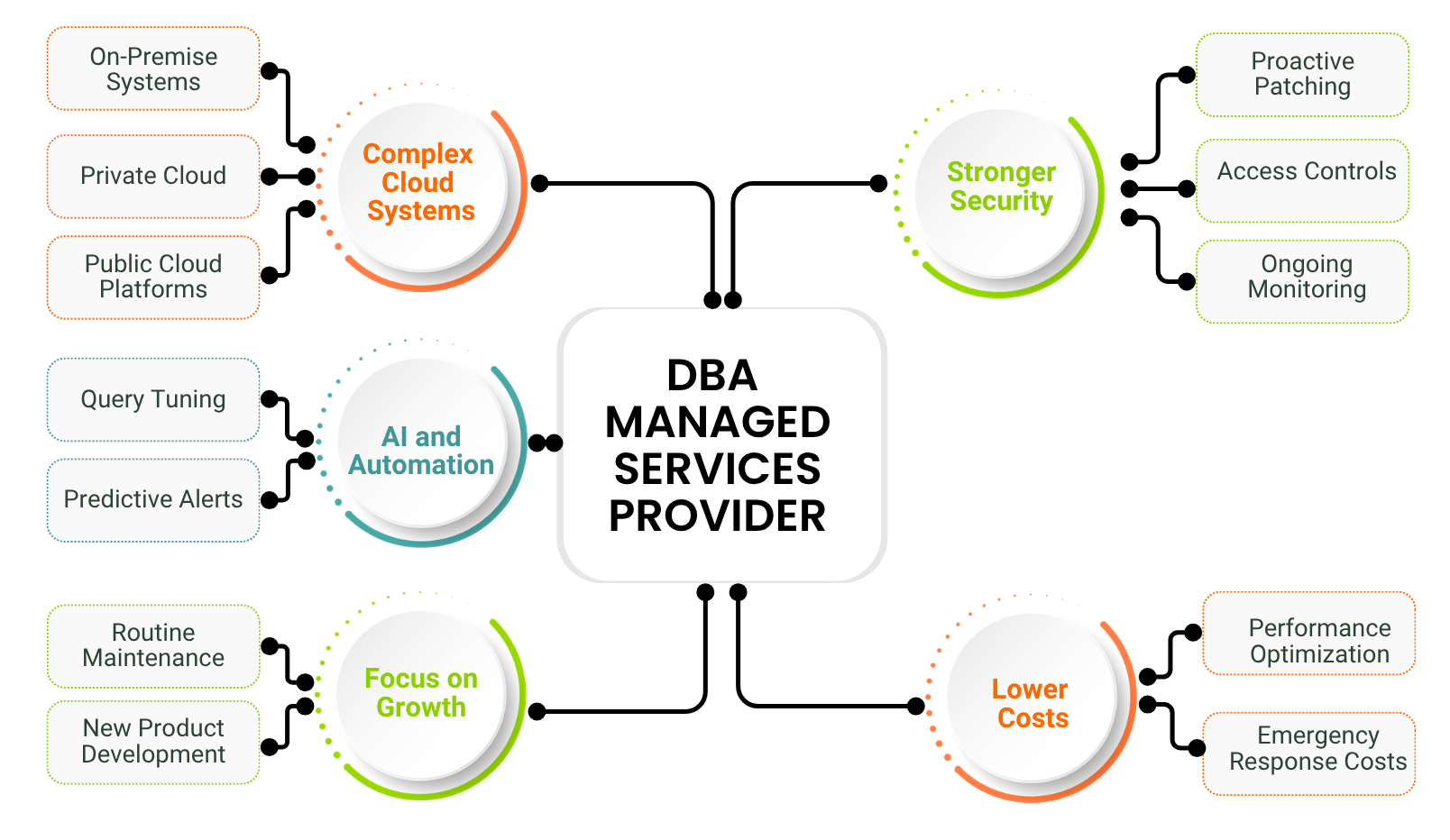
Complex cloud systems: Modern data rarely lives in one place anymore. Most enterprises run a mix of on-premise systems, private cloud, and several public cloud platforms at once. Keeping this mixed setup stable takes specialized skills that general IT teams often lack. An experienced DBA managed services team can manage hybrid and multi-cloud setups. They do it without constant firefighting when internal staff are stretched too thin.
Stronger security: Cyber threats against databases keep getting more advanced. A single unpatched flaw can expose years of sensitive customer and business data. A specialized DBA Managed Services Provider reduces these risks with proactive patching, access controls, and ongoing monitoring. This provides stronger protection than a part-time internal resource can realistically offer.
AI and automation: Database tools now use more automation and AI-based optimization, from query tuning to predictive alerts. These features can genuinely improve performance, but only when they're configured and monitored correctly. A strong provider knows how to add these tools to your environment safely, without creating new risks.
Lower costs: Preventing a database failure is almost always cheaper than fixing one after it happens. Providers who catch performance issues early, before they become outages, help avoid emergency response costs. They also help prevent lost revenue and overtime hours from reactive firefighting.
Focus on growth: Every hour an internal team spends patching, monitoring, and troubleshooting databases is an hour not spent building new products or improving the customer experience. Handing off routine database health checks and maintenance to a specialized partner frees your internal teams. They can focus on work that moves the business forward.
As an ISO-certified database management and data consulting company, GeoPITS brings the kind of documented security and process discipline enterprises increasingly expect from a DBA Managed Services Provider, not just a promise of expertise, but a certification that backs it up.
Conclusion
Choosing a DBA Managed Services comes down to a few key things that matter most. Look for real, verified expertise with the database engines you use. Make sure SLAs hold up under pressure, not just on paper. Check that security and compliance fit your industry. Choose pricing and contract terms that do not box you in. Continuous monitoring, proactive tuning, and reliable incident response help keep an enterprise’s data safe each day. This happens long before leaders notice that things went right.
Ready to see how a specialized DBA team can reduce downtime risk and free up your IT staff for higher-value work? Reach out to Geopits to discuss your current database environment. We can help you see where managed services would help most.
FAQ
1. What is a DBA managed service provider?
A DBA managed service provider is a specialized company that manages an organization’s databases each day. It handles monitoring, performance tuning, security patching, backups, and incident response. This helps internal IT teams avoid managing everything in-house.
2. How do I evaluate a database managed service provider?
Look closely at their engine-specific expertise, the strength and clarity of their SLAs, and their security certifications. Check their compliance track record and pricing transparency. Ask if they can show measurable results from current clients, not just testimonials.
3. Why is 24/7 support important for database management?
Databases don't fail on a convenient schedule. An issue at 2 AM can turn into hours of downtime and lost revenue. This happens if no one with real DBA-level skill catches it. A first-line support agent may wait to escalate it until morning.
4. What SLA response time should I expect from a DBA managed services provider?
For critical (P1) incidents, most reputable providers commit to response times of 15 to 30 minutes. Resolution targets are usually defined separately, based on issue complexity. Always get these numbers in writing, broken down by severity level.
5. What's the difference between managed DBA and remote DBA services?
Remote DBA services generally refer to on-demand, often hourly or task-based database support. Managed DBA services are broader and usually ongoing. They include monitoring, proactive tuning, security, compliance, and database planning. This is a long-term partnership, not a one-time project.
Saranya
.svg)
.svg)






.svg)


.svg)