


How Geopits stabilized a PostgreSQL database on Amazon RDS after a connection spike during a major sale

50-60%
<1,000
<100
1
About
Intentwise
The client is an e-commerce analyticsplatform whose production environment runs on Amazon RDS for PostgreSQL. Duringa major promotional sale, traffic peaked and the database came under heavy,sudden load.
Business Challenges
A sudden surge of identical, resource-heavy queries during peak sales pushed the database past its limits, with no connection-level protection in place.
Connections and database load climbed sharply during a major promotional sale.
A large number of concurrent connections executed the same query at once, driving up CPU, memory and active sessions.
The database became unresponsive and was restarted, causing more than 5 minutes of downtime.
Resource exhaustion degraded service for the application while the incident lasted.
Without pooling or timeouts, nothing limited the blast radius, and the risk of a repeat incident remained until the root cause was addressed.
Project Objectives
Geopits was asked to restore stability to the client's Amazon RDS for PostgreSQL database, find the cause of the load spike and reduce the risk of it happening again.
Key Goals:
- Monitor thedatabase after the restart and identify the query driving the load
- Mitigate theload safely, with client confirmation before any action
- Tune the queryand add connection-level safeguards to prevent recurrence
Solution Provided by Geopits
Geopits worked through the incident in order: monitor, identify, confirm with the client, mitigate, then tune.
The team watched database load (average active sessions) in Performance Insights, connection count against max_connections, and running queries and wait events through pg_stat_activity.
One query was being executed repeatedly by many concurrent connections. It accounted for the majority of database load and held sessions open long enough for connections to pile up.
Because terminating a query can affect application behavior, Geopits shared the query details with the client first. After their confirmation, the offending sessions were terminated and the load came down.
Top SQL, wait events and execution time were reviewed in Performance Insights, with recommendations on indexing, query rewrites, connection pooling, timeouts and caching.
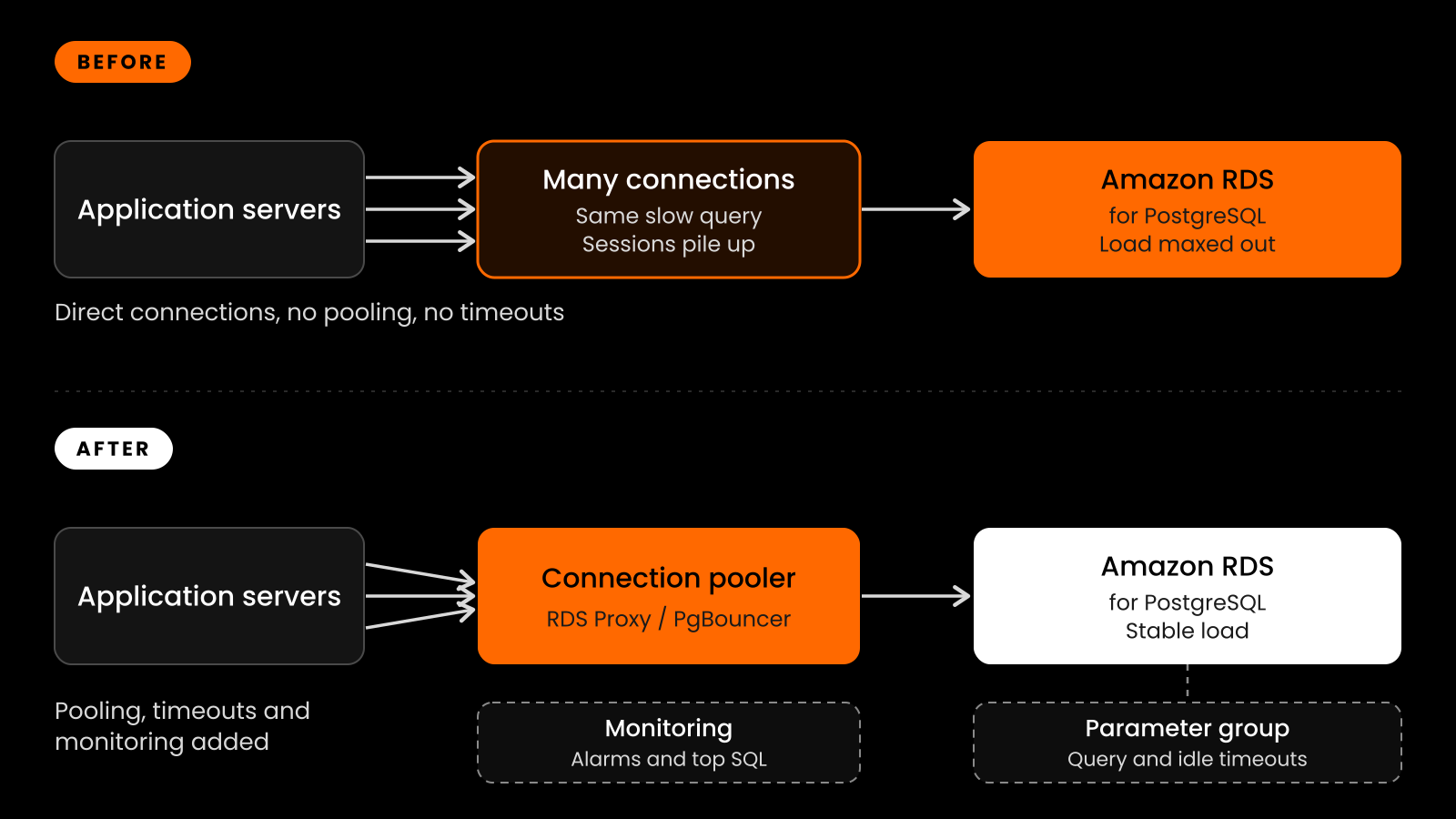
Results & Business Impact
After the client applied the recommended changes, CPU, connections and database load returned to expected levels, with database load recovering first.
Key outcomes

Root cause isolated
Client-confirmed mitigation
Metrics back to normal
Query tuned, guardrails added
Prevention built in
Conclusion
Geopits helped an e-commerce analytics platform recover from a PostgreSQL load spike on Amazon RDS during a major sale. CPU peaked at 97%, connections reached 1,070 and database load hit 400 before the team identified the single query responsible, confirmed the action with the client and recommended query tuning and connection safeguards. CPU settled at 50–60%, connections returned below 1,000 and database load fell below 100.
Ready to Transform Your Data?
Geopits works alongside your team as a strategic partner, starting with stabilizing your current databases, then modernizing your data infrastructure, and ultimately helping you unlock the full potential of AI.


Happy Clients so far
Databases Managed
Successful Migrations