.svg)
.svg)
.svg)


.svg)


.svg)
.svg)

.svg)

Your production database crashes at 2 AM on a Sunday. Who actually picks up that call? For most engineering teams, the honest answer is nobody until Monday morning. That silence is expensive. Gartner estimates the average cost of IT downtime at roughly $5,600 per minute, which quickly translates to over $300,000 an hour for a mid-size or large business. A weekend outage with no active monitoring can easily wipe out months of operational savings in a single incident. (Source)
Most organizations don't actually face a staffing shortfall; they face a structural coverage problem. Resolving the issue doesn't necessarily mean adding a full-time headcount. It requires rethinking who monitors your databases and when, which is precisely why engineering leaders evaluate managed DBA services.
This guide compares in-house and managed DBA options across actual costs, coverage gaps, scaling limits, and risk factors to help you choose the best Solution Expert.
What Is an In-House DBA?
An in-house DBA is a full-time employee dedicated to managing your database infrastructure from inside the company. They install, configure, monitor, and back up your systems as part of their regular job. They report to your internal engineering or IT leadership, not to any outside vendor. This creates a direct line of accountability that many teams find reassuring, especially in smaller organizations. The biggest strength here is familiarity. An in-house DBA lives inside your systems every day and picks up on quirks, patterns, and history that outsiders take time to learn.
Core responsibilities and daily scope
Daily work includes patching servers, tuning indexes, managing user access, and verifying backups actually completed successfully. They're also the first person paged when a query slows down or a nightly job fails. In-house DBAs perform best in tightly regulated, single-platform environments where long-term context outweighs broad coverage needs. A bank running one core banking system for a decade benefits from that continuity.
But this strength has a clear downside. One person means one point of failure, and when they're sick, on leave, or gone, your coverage disappears with them.
What Are Managed DBA Services?
Managed DBA services shift database operations to a specialized third-party provider instead of an internal hire. The provider proactively monitors, tunes, patches, and secures your systems, often across multiple platforms and clients at once. Instead of relying on one person for one system, you get access to an entire team of certified DBAs. Geopits, for example, runs round-the-clock remote support across SQL Server, MySQL, PostgreSQL, Oracle, and MongoDB.
Pricing typically runs on a subscription or retainer basis, tied to the number of databases or instances covered. That structure gives finance teams a predictable line item instead of a volatile headcount cost.
How the managed or outsourced model works
In a managed or outsourced model, a company hires an external vendor to take over specific business functions, operations, or technical infrastructure. The client defines the required service levels, while the third-party provider manages the daily execution, staffing, and quality control to deliver agreed-upon business outcomes.
- Initial Assessment & Baselining: The team evaluates your current database health, architecture, and performance baseline.
- Integration & Setup: Geopits integrates with your internal tools and ticketing workflows to act as an extended team.
- 24/7 Shared Support: Continuous monitoring tracks metrics, handles alerts, and executes routine maintenance via their remote command center.
- Dedicated Management: A customer success manager acts as your primary point of contact for routine reporting, health check reviews, and strategy scaling.
- Ongoing Monitoring & Billing: The vendor monitors performance continuously, usually charging a predictable monthly fee or subscription.
Key Characteristics
- Accountability: The vendor manages their own team members and operational bottlenecks.
- Approach: Services are proactive, focusing on system optimization and continuous improvement rather than just completing isolated tasks.
- Control: The client retains high-level strategic governance while delegating hands-on technical execution and risk
What's typically included in managed DBA services
Managed Database Administrator (DBA) services typically include round-the-clock performance monitoring, automated backups, disaster recovery, security patch management, and proactive query tuning. They handle routine maintenance and emergency troubleshooting so internal teams can focus on core application development.
In-House DBA vs. Managed DBA Services: Key Differences
An in-house DBA provides dedicated, on-site control and deep custom integration with company applications. Conversely, managed DBA services offer cost-effective, round-the-clock remote monitoring and multi-platform expertise through a predictable subscription model. Choosing between them depends on your budget, uptime requirements, and internal resource constraints.
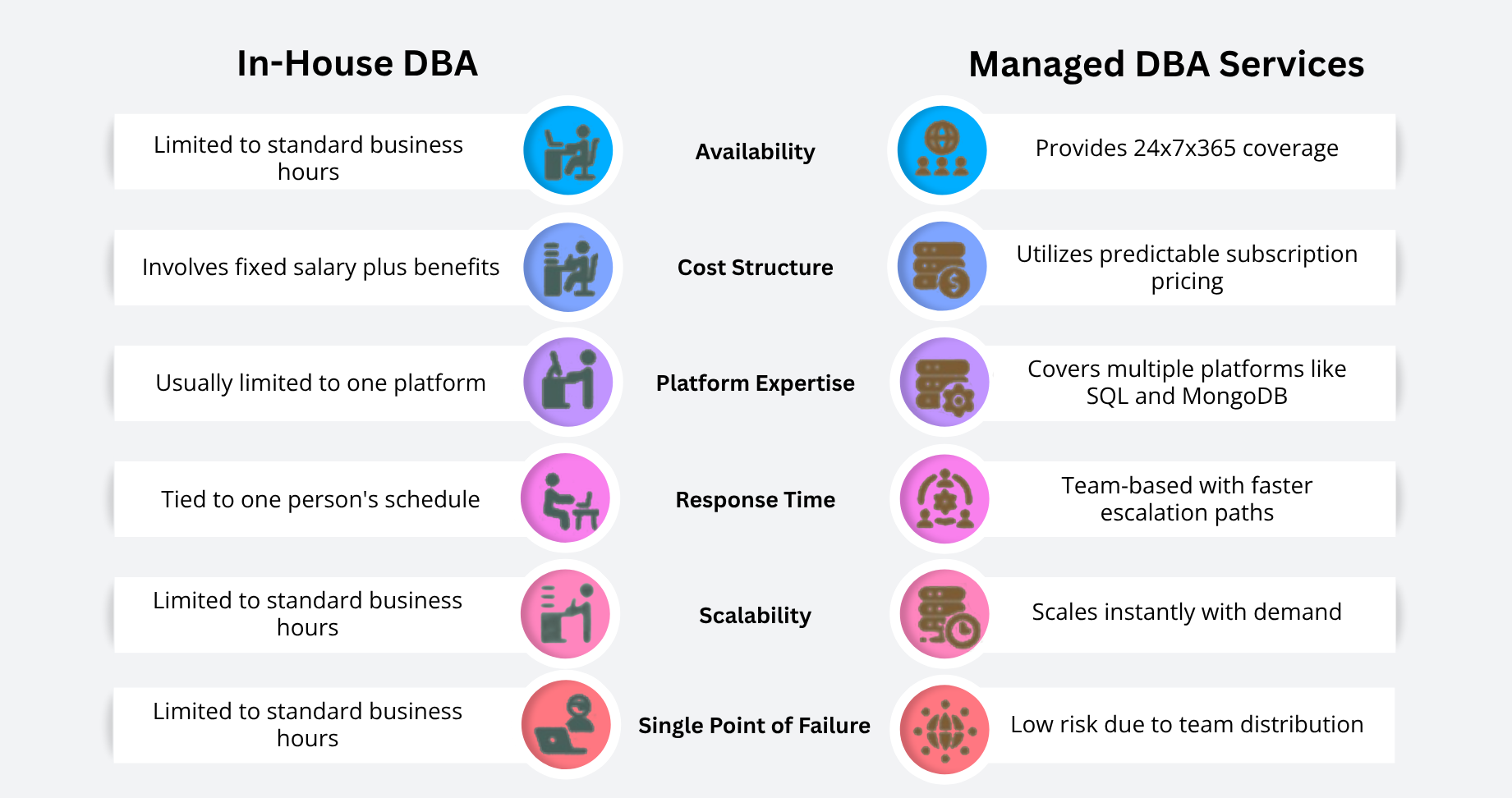
Key takeaway for decision-makers: A single-platform team with stable, low-growth workloads can still make in-house work well. A scaling, multi-platform team needing round-the-clock reliability usually outgrows that model fast.
Cost Comparison: In-House DBA vs. Managed DBA Services
Choosing between an in-house Database Administrator (DBA) and managed DBA services involves balancing fixed payroll overhead against predictable subscription pricing. While an in-house senior DBA carries high baseline salary, benefits, training, and recruitment costs, managed services bundle 24/7 monitoring, multi-platform expertise, and disaster recovery into a single operational fee.
True cost of an in-house DBA: A senior in-house DBA in India commands a strong annual salary before adding PF, insurance, bonuses, and software licenses. Replace that person once, and you absorb recruitment and ramp-up costs all over again.
True cost of managed DBA services: Managed services run on monthly or instance-based pricing tied to your database count and support tier, so expenses stay predictable. Geopits structures its services as a shared-service model, meaning you pay for coverage, not headcount, and often save 40 to 70 percent overall.
Availability and Support: 24/7 Coverage vs. Business Hours
What actually happens when your database fails at 3 AM on a weekend? For most in-house setups, it means a delayed fix, a frustrated customer, and one exhausted engineer.
Coverage gaps with in-house teams: In-house DBAs typically work standard business hours, leaving nights, weekends, and holidays uncovered by default. One missed after-hours incident can outweigh an entire year of subscription savings elsewhere.
Round-the-clock coverage with managed services: Managed providers staff shifts across time zones, so someone is always actively watching your infrastructure. Geopits runs this exact model, with certified DBAs monitoring client systems continuously, not just during office hours.
Expertise and Skill Coverage
Most in-house DBAs go deep on one platform, whether that's SQL Server, Oracle, or PostgreSQL specifically. That depth is fine until your business adopts a technology they've never actually worked with.
Single-platform risk with in-house teams: Say your company adopts MongoDB for a new product line, but your DBA only knows SQL Server well. You're now stuck hiring again, training from scratch, or carrying risk you didn't plan for.
Multi-platform depth with managed services: Managed providers maintain dedicated teams across SQL Server, MySQL, PostgreSQL, and MongoDB simultaneously, so platform diversity stops being a hiring headache. You also get on-demand access to migration or tuning specialists without adding permanent headcount.
Security, Compliance, and Risk Management
Frameworks like HIPAA, GDPR, and SOX demand database-level expertise that most in-house hires don't build until forced to. Getting compliance wrong here isn't a small mistake; it exposes you to real legal and financial risk.
Compliance risk with in-house teams: If your only DBA leaves suddenly, so does their knowledge of your security configurations and access rules. One person carrying that much regulatory context alone is a structural risk, not just a staffing gap.
Built-in compliance with managed services: Managed DBA providers build compliance and audit support directly into their process, since they apply it across dozens of clients already. That repetition creates consistency, and spreading knowledge across a team removes the single-point-of-failure risk entirely.
Scalability: Growing With Your Business
Hiring a new in-house DBA takes weeks, sometimes months, right when your growth spurt needs support immediately. That lag between real need and an actual hire is where scaling plans quietly stall out.
Hiring lag with in-house teams: Every new platform, spike, or migration project potentially means another job posting, interview cycle, and onboarding period. Growth ends up gated by recruitment speed instead of actual business demand.
On-demand scaling with managed services: Managed DBA services scale up or down with your workload, without new headcount approvals or long recruitment cycles. Cloud migrations, seasonal spikes, and platform upgrades all get absorbed as part of the existing service.
Real-World Case Studies: Managed DBA Services in Action
The key challenge: A global retail bank running core financial applications on legacy SQL Server 2000 needed a full migration to SQL Server 2017. With millions of daily transactions, even brief downtime risked disrupting core banking operations.
Solution: Geopits deployed a staged migration strategy, moving 345 ETL packages and 3.3 TB of data while testing extensively in UAT before cutover. The result: the entire migration was completed in just 2 hours of planned downtime, with SSIS package execution running 5x faster afterward and delivered on schedule in 5 months.
This is the exact gap that in-house teams struggle to close on their own, because large-scale migrations require specialized bandwidth that most single-DBA setups do not have available. Read the full case story →
When Should You Choose Managed DBA Services?
Choose Managed DBA (Database Administrator) services when your team lacks specialized database skills, cannot afford round-the-clock staffing, or needs to shift focus from routine maintenance like backups and patching to core product development. They are also ideal for scaling operations cost-effectively without full-time hiring overhead. Key Signs You Need Managed DBA Services:
- No In-House Experts: Your developers or general IT staff spend too much time fixing database issues instead of building software.
- Need for 24/7 Uptime: Your business cannot risk crashes or data loss outside normal working hours and needs round-the-clock monitoring.
- High Hiring Costs: Recruiting, training, and retaining a full-time, experienced database specialist costs more than a flexible service provider contract.
- Complex Maintenance Needs: Your systems require constant security updates, performance tuning, and reliable disaster recovery planning that your current team cannot manage.
Why Geopits for Managed DBA Services
Geopits delivers specialized 24/7 database administration and managed DBA services to ensure optimal uptime, proactive threat detection, and performance tuning. They manage major platforms like SQL Server, Oracle, PostgreSQL, MySQL, and MongoDB across hybrid and multi-cloud environments. Here are the key advantages of managed DBA services in Geopits:
- 24/7 Proactive Monitoring: Continuous monitoring via automated tools like GeoOps to spot threshold violations and resolve incidents quickly.
- Guaranteed SLAs: Rapid response times (often 5–10 minutes) for critical issues and commitments to high availability.
- Performance Tuning & Cost Optimization: Deep query optimization and configuration tuning that improve throughput and reduce unnecessary cloud compute costs.
- Security & Compliance: Frameworks aligned with ISO 27001 standards for safe audits, role-based access, and vulnerability assessments.
Conclusion
The in-house vs. managed DBA decision ultimately comes down to control versus cost, expertise, and resilience. Both models solve real problems, just for different kinds of organizations at different growth stages. Lean, growing, multi-platform teams generally extract more value from managed services over time. Highly specialized, resource-rich organizations with stable, single-platform needs may still justify keeping an in-house hire around.
Before deciding, map your actual downtime risk, platform spread, and hiring bandwidth honestly and specifically. Geopits offers a database health check to help you see exactly where your current setup stands today.
FAQ
1. Is managed DBA service cheaper than an in-house DBA?
Usually, yes. Managed services skip salary, benefits, training, and turnover costs, often saving 40 to 70 percent versus an equivalent in-house hire over time.
2. Can managed DBA services handle multiple database platforms?
Yes. Providers like Geopits support SQL Server, MySQL, PostgreSQL, Oracle, and MongoDB under one contract, removing the single-platform limitation common with in-house hires.
3. Is my data secure with a third-party DBA provider?
Reputable providers apply strict access controls, encryption, and compliance frameworks aligned with HIPAA, GDPR, and SOX, often exceeding what one in-house DBA can maintain alone.
4. How fast is incident response with managed DBA services?
Managed teams typically respond within minutes under defined SLAs, since coverage runs 24x7 across shifts instead of depending on one person's availability.
5. Can I switch to managed DBA services without downtime?
Yes. Providers run parallel onboarding, shadowing your current setup before fully taking over, so the switch happens without disrupting production systems at all.

Prabhu Sundaram
.svg)
.svg)

.avif)