AI data readiness means enterprise data holds the accuracy, structure, context, and governance required for generative AI and machine learning systems to produce trustworthy results. Building it involves cleaning data, mapping metadata, unifying sources, and applying governance before any model touches production.
Key Takeaways
- Enterprises that treat data preparation as a foundation, rather than an afterthought, see faster returns from their generative AI investments.
- Gartner links weak data foundations directly to abandoned AI projects, making readiness a budget decision as much as a technical one.
- Governance, metadata, and unstructured data quality form the backbone of a mature AI data readiness program.
- A phased, use case-driven approach helps teams build readiness gradually, rather than attempting a single sweeping overhaul.
Generative AI promises faster decisions, sharper personalization, and automation that once seemed years away. Yet the technology only performs as well as the data beneath it. Enterprises pouring budget into large language models and machine learning pipelines often discover that the real obstacle sits further upstream, buried in spreadsheets, legacy systems, and inconsistent records. This gap between ambition and infrastructure has a name: AI data readiness. It describes the work of shaping enterprise data so it becomes fit for AI consumption, rather than merely fit for human eyes in a quarterly report.
What Is AI Data Readiness?
AI data readiness refers to the state where enterprise data satisfies the accuracy, completeness, context, and accessibility requirements that generative AI and machine learning systems demand to function reliably. Unlike a general data quality checklist, readiness for AI factors in how a model will consume, interpret, and act on information. A customer record that looks fine In a CRM report, naming conventions may vary, timestamps may conflict, or metadata may be missing entirely, which can still confuse a language model.
Gartner frames this distinction sharply: a survey of over a thousand data management leaders found that a majority either lacked the right data management practices for AI or remained uncertain whether their practices qualified. That uncertainty matters because AI systems amplify small data flaws into large output errors, unlike a static dashboard where a stray null value might go unnoticed for months.
Why Does AI Data Readiness Matter for Enterprise AI Success?
Enterprise AI success depends on a foundation few leaders examine closely until a project stalls. Breaking this question into its core drivers shows exactly where the stakes sit.
The Financial Risk of Skipping Readiness
Gartner predicts that through 2026, organizations will abandon 60 percent of AI projects built on data that lacks AI readiness. That figure represents wasted engineering hours, stalled pilot programs, and executive sponsors who lose confidence in AI as a strategic tool. Every abandoned project also carries an opportunity cost, since the budget and talent devoted to it could have supported an initiative with stronger data foundations from the outset.
The Current State of Enterprise Readiness
Separate Gartner research paints a sobering picture of where enterprises stand today: only 43 percent of organizations describe their data as ready for AI use, even as spending on AI data tooling grows far faster than infrastructure spending. That imbalance signals a market racing to solve a foundational problem rather than a niche concern reserved for data engineers.
Why This Deserves Board-Level Attention
Together, these figures explain why readiness deserves attention from executive leadership, rather than remaining a task delegated quietly to a data engineering backlog. When budget and governance and business strategy align around data readiness from the start, AI initiatives have a far stronger chance of reaching production and delivering measurable value.
What Are the Core Pillars of AI Data Readiness?
Enterprise leaders often ask what separates a mature readiness program from a scattered cleanup effort.
- Data quality and accuracy: Values, labels, and records need consistency across every source system a model touches.
- Metadata and context: Semantic tagging, lineage tracking, and documentation give models the surrounding information required to interpret data correctly.
- Unification across silos: Structured databases, unstructured documents, images, and logs need a common pathway into the AI pipeline.
- Governance and compliance: Access controls, privacy safeguards, and audit trails protect the organization as data flows into new systems.
- Scalability: A readiness program built for one use case should extend to future initiatives, rather than requiring a rebuild each time.
- Continuous validation: Readiness is a living state. Data drifts, source systems change, and validation needs to happen on an ongoing basis rather than a single audit.
How Do You Assess Your Organization's AI Data Readiness?
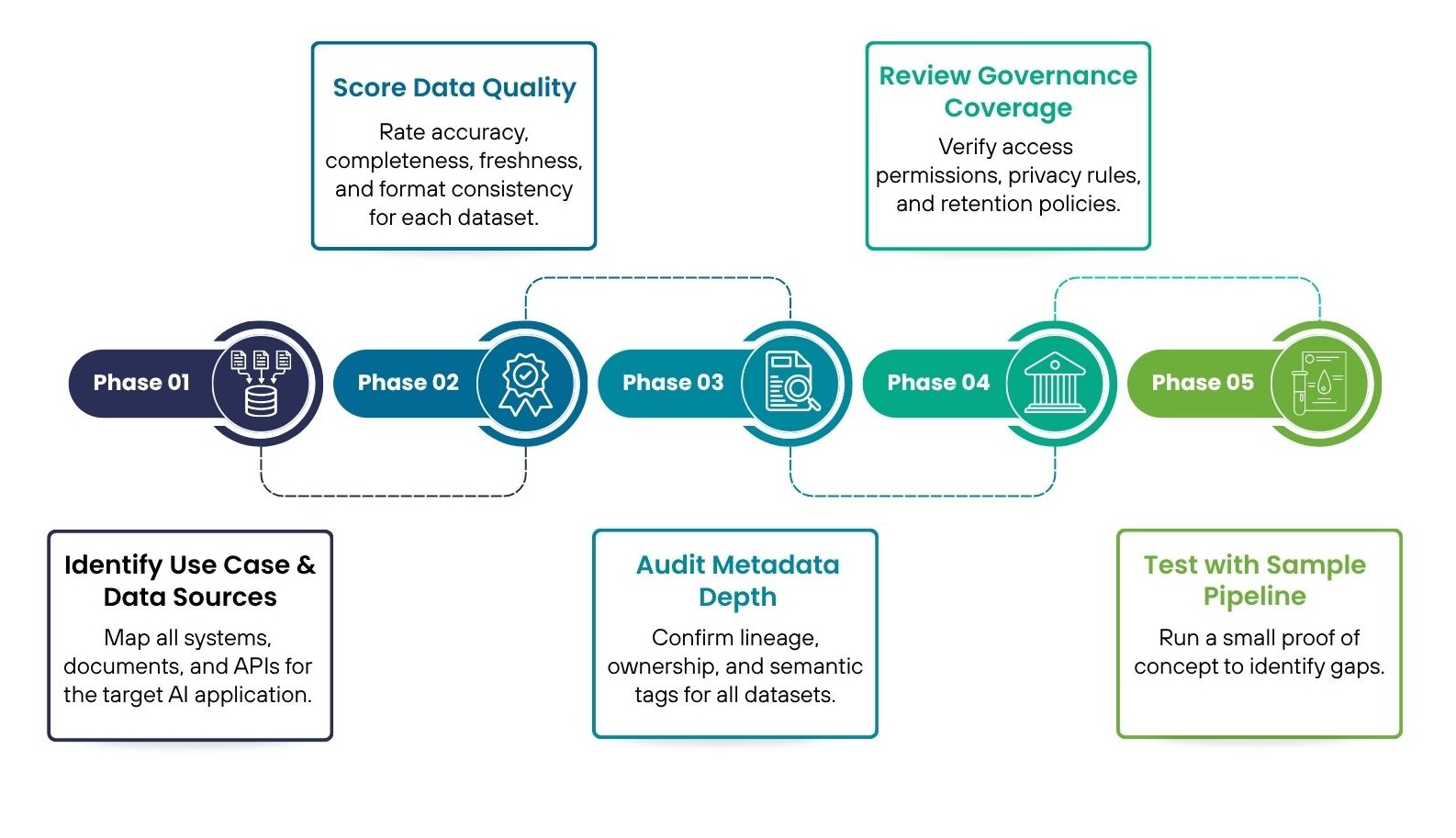
A practical assessment starts with a use case, rather than a sweeping enterprise-wide audit. Teams gain clarity faster when they pick one high-value AI application, such as a customer support assistant or a sales forecasting model, and trace every data source that feeds it.
A useful assessment sequence looks like this:
- Identify the target use case and required data sources: Map every system, document repository, and API the AI application will touch.
- Score data quality against AI-specific criteria: Accuracy, completeness, freshness, and format consistency each deserve a rating, rather than a pass or fail label.
- Audit metadata depth: Confirm whether lineage, ownership, and semantic tags exist for each dataset.
- Review governance coverage: Verify that access permissions, privacy rules, and retention policies align with how AI systems will use the data.
- Test with a sample pipeline: Running a small proof of concept surfaces gaps that a written audit alone might miss.
This staged approach mirrors what Gartner recommends for enterprise governance of AI, a framework built around cross-domain collaboration rather than isolated technical fixes.
What Are the Biggest Barriers to AI Data Readiness?
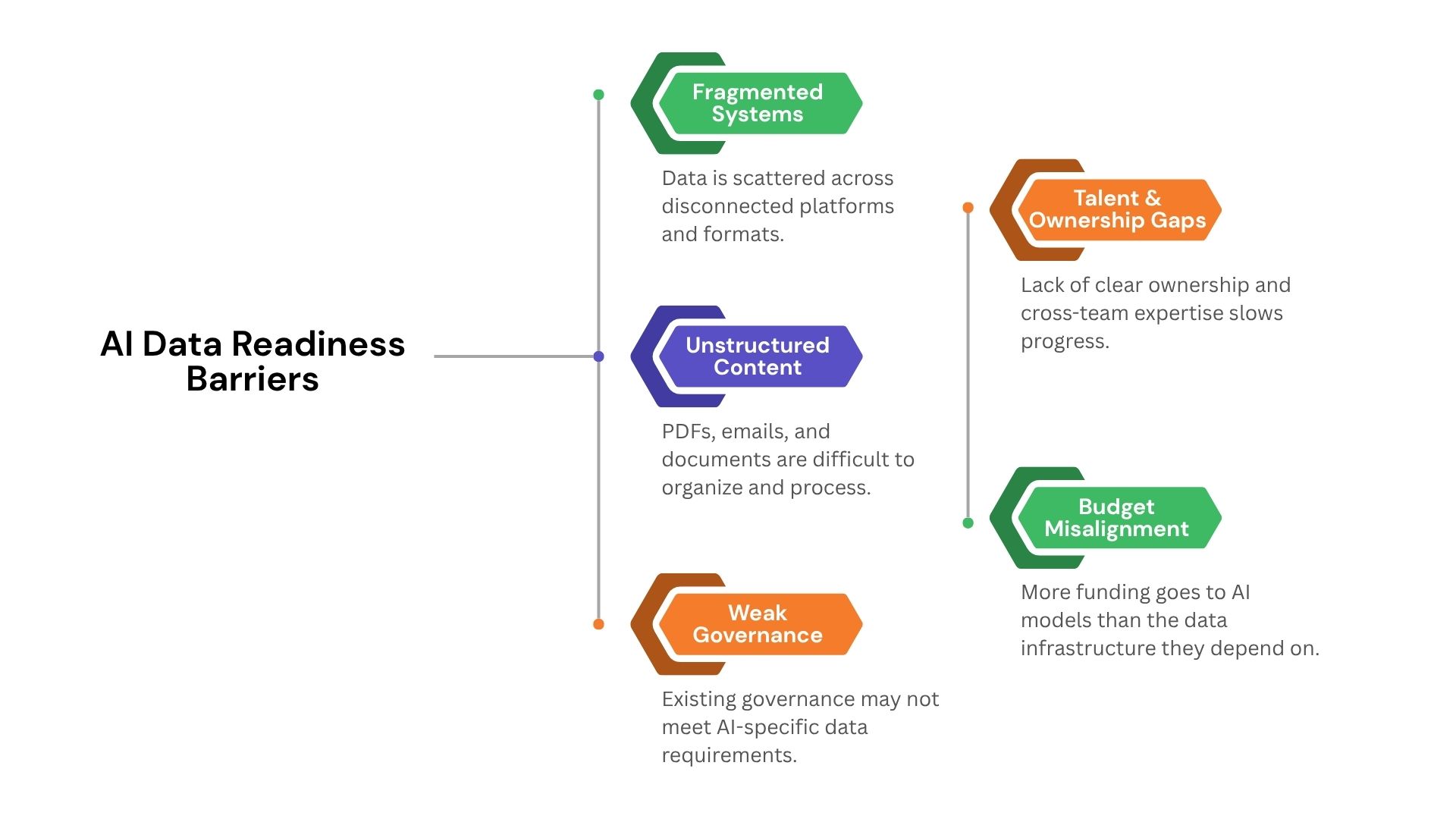
- Fragmented systems: Enterprise data is often spread across dozens of disconnected platforms, each with its format and update cadence, making unification a significant challenge.
- Unstructured content: Documents, emails, PDFs, and scanned files hold enormous value, yet they resist the kind of clean structure that traditional pipelines expect.
- Weak governance maturity: Many organizations built governance frameworks for compliance reporting, a purpose far narrower than what AI systems require.
- Talent and ownership gaps: Readiness spans data engineering, security, legal, and business teams, and unclear ownership slows progress considerably.
- Budget misalignment: Funding often flows toward model development, while the underlying data infrastructure receives a smaller share despite carrying equal importance.
Harvard Business Review Analytic Services and Cloudera found that 73 percent of surveyed organizations felt their organization should prioritize AI data quality more heavily than it currently does. That statistic captures a widespread awareness gap: leaders recognize the problem, yet execution lags behind intention.
What Role Does Data Governance Play in AI Data Readiness?
Governance sits at the center of any durable readiness program. Enterprise AI systems constantly touch sensitive information, from customer records to financial data, and governance frameworks decide who accesses that information, how long it persists, and under what conditions a model can use it.
Gartner recommends enterprise governance of AI, a flexible structure that combines existing IT, data, and risk governance domains into a coordinated decision-making layer. This approach helps CIOs and chief data officers connect governance decisions directly to business objectives, rather than treating governance as a separate compliance exercise disconnected from AI strategy.
Strong governance also builds trust with regulators, customers, and internal stakeholders. As generative AI applications expand into higher-stakes areas like healthcare, finance, and legal services, governance maturity becomes a competitive differentiator rather than a background requirement.
How Does AI Data Readiness Differ From Traditional Data Quality?
Traditional data quality programs focus on accuracy, completeness, and consistency within a defined reporting context. A finance team validating quarterly numbers cares whether totals reconcile and whether fields match expected formats. AI data readiness extends far beyond that scope, since models consume enormous volumes of structured and unstructured data simultaneously and interpret context in ways a static report never attempts.
How to Evaluate Your Data Readiness for the AI-Driven Future
The future of AI data readiness centers on shifting from static, siloed data storage to dynamic, context-rich, and real-time governance designed for autonomous and generative systems.
- Unstructured Data Integration: Moving beyond tables to ingest documents, code, and diagrams.
- Real-Time Processing: Replacing batch updates with live data streaming for inference.
- Agentic Governance: Establishing strict rules for autonomous AI reading and writing.
- AI-Driven Automation: Using generative tools to automate data labeling and cataloging.
- Continuous Readiness: Treating readiness as an ongoing, use-case-specific lifecycle rather than a one-time fix.
Market signals point toward sustained, rapid growth in AI data infrastructure investment. Analysts at Gartner project that the AI data market will expand from roughly 134 million dollars in 2024 to nearly 14.6 billion dollars by 2029, a growth rate that outpaces AI infrastructure spending by a wide margin. This trajectory suggests enterprise leaders increasingly view readiness as a strategic investment category rather than a supporting cost center.
How Does Geopit Help Enterprises Build AI Data Readiness?
Geopit turns the AI data readiness framework outlined above into working infrastructure for enterprise teams. A recent Geopit engagement with a leading Indian automotive manufacturer shows the framework in practice: production, dealer, inventory, sales, and service data sat scattered across separate systems, limiting visibility and slowing demand planning. Geopit unified these sources into a single AI data platform, adding demand forecasting, predictive maintenance, and after-sales analytics on top of a governed data foundation. The result included 99.99 percent uptime maintained, five or more databases optimized, and zero downtime during rollout.
Read the full story here: How Geopits Transformed Automotive Manufacturing with an AI Data Platform
Conclusion
AI data readiness determines whether generative AI and machine learning initiatives deliver real value or stall in pilot mode. Enterprises that invest in unified data, strong governance, and rich metadata see faster, more reliable AI outcomes. Geopit's automotive manufacturing engagement shows what success looks like in practice: fragmented systems became a single connected foundation.
Ready to Transform Your Data?
Geopit works alongside your team as a strategic partner, starting with stabilizing your current databases, then modernizing your infrastructure, and ultimately helping you unlock the full potential of AI. Book a Demo and take the first step toward AI data readiness.
Frequently Asked Questions
1. Is AI data readiness the same as data governance?
Governance forms one pillar of AI data readiness, covering access, compliance, and audit trails. Readiness extends further, adding metadata depth, unification across sources, and continuous validation tailored to AI use cases.
2. How much does poor data readiness cost an enterprise?
Costs show up as abandoned AI projects, wasted engineering time, and delayed returns on investment. Gartner links weak data foundations directly to the majority of AI projects that organizations abandon before reaching production.
3. Can small and mid-sized enterprises achieve AI data readiness?
Yes, through a phased, use-case-driven approach. Starting with one high-value application, rather than an enterprise-wide overhaul, gives smaller teams a practical path toward measurable readiness within a few quarters.
Saranya