
.svg)
.svg)
.svg)


.svg)


.svg)
.svg)

.svg)

Summary:
- Proactive beats reactive: Managed DBA services continuously monitor and tune your systems, fixing hidden issues before expensive crashes disrupt your daily business operations.
- Huge cost savings: You gain access to an entire team of top-tier database experts without paying hefty six-figure internal salaries.
- True 24/7 protection: Databases fail at all hours; dedicated managed support ensures expert eyes guard your data and backups day and night.
- Stress-free cloud scaling: Moving to complex cloud environments becomes smooth and secure while keeping your sensitive customer data fully compliant.
Every business decision today runs through a database somewhere. Orders, records, transactions, and customer data; most executives never think about where it lives until something breaks.
Things do break, and moving to the cloud hasn't solved that problem the way many businesses expected. Cloud infrastructure takes care of servers and storage, but it doesn't tune a slow query, catch a failing backup, or patch a security gap before someone finds it. Databases still need people watching them closely.
That's the real problem. Database platforms keep getting more complex, not less, and most in-house teams don't have the time or the specialized knowledge to manage all of them well. This is where managed DBA services come in. Instead of waiting for a database to fail and then scrambling to fix it, businesses are turning to database managed services that monitor, tune, secure, and maintain systems continuously. It's a shift from reactive firefighting to steady, planned DBA support, and it's changing how companies of every size handle their data.
What Are Managed DBA Services?
Managed DBA services are an arrangement where a specialized provider takes over daily database administration. This includes monitoring performance, applying patches, and managing backups. It also covers tuning queries, handling security, and staying available when something goes wrong. Support is often available at any hour of the day or night.
Rather than building a full internal database team, a business can access that same expertise through a partner. This avoids the overhead of hiring, training, and retaining specialized staff. The provider becomes part of the IT function, handling the technical depth internal teams rarely have time to build.
Types of Databases Supported by Managed DBA Services
A good DBA support provider doesn't specialize in just one platform. Businesses run mixed environments, so support needs to stretch across relational, NoSQL, and cloud-native databases.
Why Businesses Are Moving to Managed DBA Services
Businesses are moving to managed DBA services to lower costs, gain round-the-clock support, and access specialized database experts. This shift helps companies fix performance issues early, improve data security, and let in-house teams focus on core growth goals instead of routine maintenance.
Here are the benefits of using a remote DBA managed service:
Increasing Database Complexity
Companies no longer run one database on one server. They run hybrid environments with on-premise systems talking to cloud databases, replication across regions, and multiple engines serving different applications. Keeping all of that stable takes specialized knowledge that's hard to build in-house without years of investment.
Rising Cost of Hiring Experienced DBAs
Senior database administrators are expensive, and finding one who's genuinely skilled across multiple platforms is harder still. Salary data from recruiting platforms consistently shows experienced DBAs commanding six-figure salaries in most major markets, and that's before benefits, training, and the cost of a slow hiring process. A managed DBA services model gives businesses access to that same expertise for a fraction of the cost of a full internal team.
Need for 24/7 DBA Support
Databases don't fail on a nine-to-five schedule. A backup job can fail at 2 a.m., a query can start choking a production system on a weekend, and customers notice immediately when an app slows down or goes offline. Without round-the-clock DBA support, businesses are left hoping nothing breaks outside business hours, which isn't a strategy; it's a gamble.
Cloud Migration Challenges
Moving a database to AWS RDS, Azure SQL, or Google Cloud SQL sounds simple on paper. In practice, it involves schema conversion, downtime planning, data validation, and performance tuning that's specific to cloud environments. Migrations that are rushed or handled by generalist IT staff tend to surface performance problems months later, once the cost of fixing them has gone up.
Growing Security & Compliance Requirements
Regulatory pressure on data handling keeps increasing, and databases sit right at the center of that pressure. A single misconfigured permission or unpatched vulnerability can turn into a compliance violation with real financial consequences.
- HIPAA: Patient data must stay encrypted, with strict access controls and audit logging across healthcare systems.
- GDPR: Businesses need to minimize data collection, support the right to erasure, and report breaches within tight timelines.
- PCI DSS: Cardholder data needs encryption, along with network segmentation and regular vulnerability scanning.
Core Database Managed Services Every Business Should Expect
A managed database service lets a business outsource routine maintenance, monitoring, backups, and security. Essential capabilities to expect include 24/7 system surveillance, automated backups, performance tuning, software patching, and robust disaster recovery. These services keep data safe and systems fast without requiring a large in-house team.
24/7 Database Monitoring
- Tracks performance, uptime, and error logs around the clock, including nights and weekends.
- Flags unusual activity early, so problems get caught before users notice a slowdown.
Database Performance Optimization
- Reviews slow queries and rewrites them for faster execution.
- Adjusts indexes and configuration settings as data volume and traffic grow.
Backup Management & Disaster Recovery
- Runs scheduled backups and checks that they complete successfully every time.
- Tests recovery plans regularly, so restoring data actually works when it's needed.
Database Health Checks
- Audits configuration, storage use, and indexing on a routine schedule.
- Identifies small issues, like fragmented indexes or outdated statistics, before they slow things down.
Database Security Management
- Reviews user access and permissions to limit exposure to sensitive data.
- Applies security patches and monitors for suspicious login or query activity.
Database Migration Services
- Plans moves between platforms or into the cloud with minimal downtime.
- Validates data after migration to confirm nothing was lost or altered.
Patch & Version Upgrades
- Tests new patches and versions in a staging environment first.
- Applies updates on a planned schedule, so production systems stay current and stable.
High Availability & Replication
- Sets up failover systems, so one server going down doesn't stop the business.
- Manages replication across servers or regions to keep data consistent everywhere.
Capacity Planning
- Forecasts storage and compute needs based on current growth trends.
- Recommends upgrades ahead of time, avoiding last-minute scrambles for resources.
Database Automation
- Scripts routine tasks like index rebuilds and log cleanup.
- Reduces manual work and human error across repetitive maintenance jobs.
Top Benefits of Managed DBA Services for Modern Businesses
- Cost Efficiency: Cuts the high cost of hiring full-time, in-house database teams.
- Round the Clock Support: Provides continuous 24/7 monitoring and fast response times for emergencies.
- Proactive Performance: Speeds up queries and stops crashes before they start.
- Better Security: Keeps data safe with strong updates, patches, and safety checks.
- Easy Scaling: Grows storage and resources up or down to fit current business needs.
McKinsey research on enterprise data costs found that fragmented, poorly maintained data systems can eat up between 15 and 20 percent of the average IT budget, often without businesses realizing where that money is going. That gap is exactly what proactive database managed services are built to close, catching inefficiencies early instead of letting them quietly drain the budget year after year.
Signs Your Business Needs Managed DBA Services
- Databases responding slower than they used to, especially during peak hours
- Outages or crashes happening more than once in a while
- Cloud infrastructure growing faster than your team's ability to manage it
- Backups that fail silently or haven't been tested recently
- No documented disaster recovery plan, or one that's never been rehearsed
- An internal DBA stretched across too many systems and priorities
- Ongoing worry about who has access to sensitive data
- Rapid business growth outpacing current database capacity
Industries That Benefit Most from Database-Managed Services
Industries that handle high transaction volumes, strict compliance rules, or sensitive data benefit most from database managed services. Top sectors include finance, healthcare, e-commerce, and SaaS technology, which rely on outsourced administration for high uptime, robust security, and seamless scalability.
- Healthcare: Patient records demand strict uptime and HIPAA-compliant handling. A database outage in a hospital system isn't just an inconvenience; it can delay care.
- Financial Services: Banks, fintechs, and payment processors run on transactional systems that can't tolerate downtime or data inconsistency, and PCI DSS compliance adds another layer of pressure.
- E-Commerce and Retail: Traffic spikes during sales events can overwhelm databases. A slow checkout page during a big promotion translates directly into lost revenue.
According to a Forbes Technology Council survey, data silos affect nearly three in four IT and security professionals, leading to reduced productivity for 82% and slower security response times for 63%. Because poorly managed databases often cause these silos, managed DBA services help close these gaps by keeping systems connected, monitored, and properly governed.
Future Trends in DBA-Managed Services
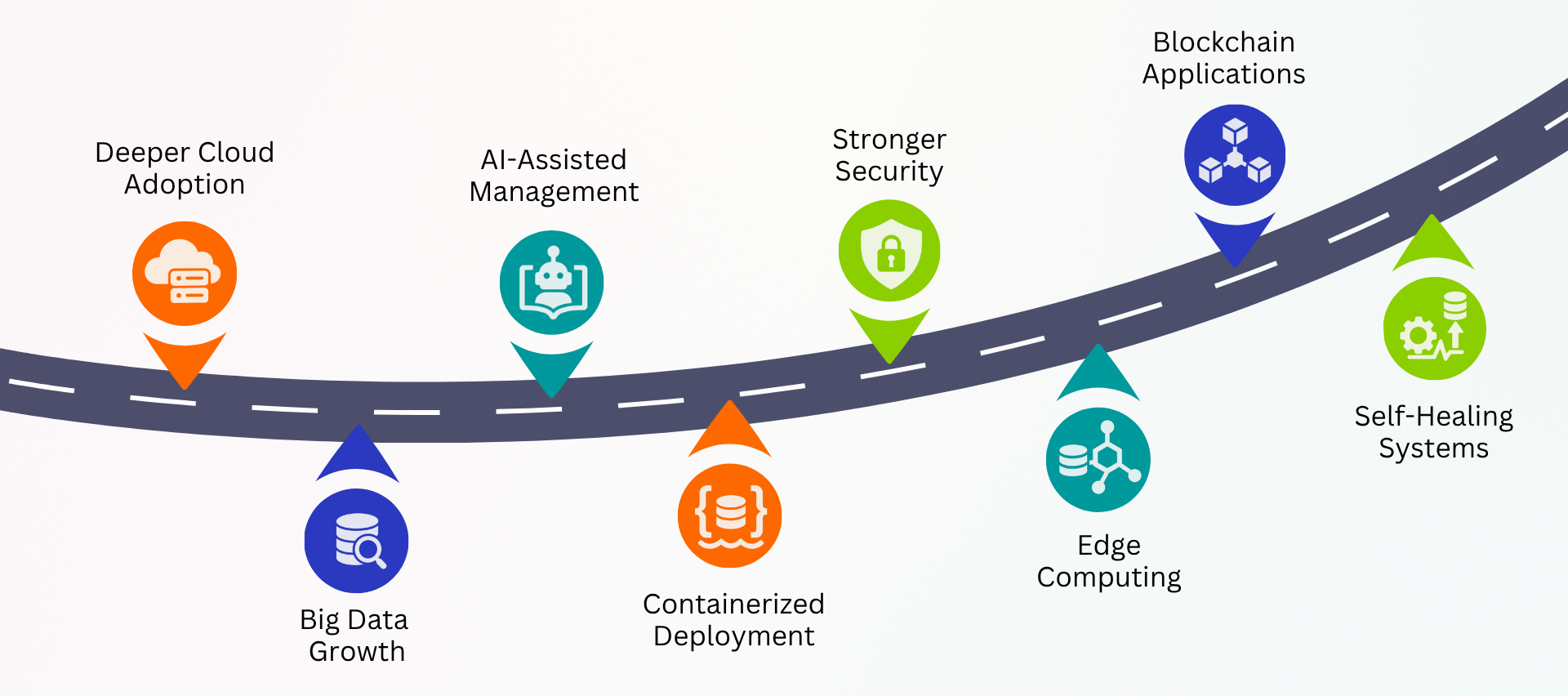
Database administration keeps changing as new technology reshapes how businesses store and manage data. Here are the trends worth watching, based on where the industry is heading.
- Deeper Cloud Adoption: More businesses will keep shifting workloads to cloud platforms for scalability and cost control. Database administrators will need stronger skills in managing cloud-native environments and using built-in cloud features to keep systems efficient and reliable.
- Big Data and Analytics Growth: As data volume and variety continue to expand, demand will grow for DBAs who are comfortable with big data tools and NoSQL systems. Managing distributed databases and turning large datasets into usable insights will become a bigger part of the job.
- AI-Assisted Database Management: Machine learning is starting to support tasks like performance tuning, anomaly detection, and security monitoring. Expect more AI-driven automation handling routine database work, freeing administrators to focus on strategy instead of repetitive maintenance.
- Containerized Database Deployment: Tools like Docker and Kubernetes are becoming common for deploying and scaling databases. DBAs will increasingly manage systems inside containerized and microservices-based architectures rather than traditional standalone server setups.
- Stronger Security and Compliance Focus: Data privacy rules keep tightening, pushing database teams to strengthen access controls, encryption, and audit trails. Staying compliant with regulations like GDPR, HIPAA, and CCPA will demand constant attention, not a one-time setup.
- Edge Computing Expansion More devices generating real-time data means databases increasingly need to run closer to where that data is created. DBAs will manage distributed systems built for low latency performance and consistency across scattered locations.
- Emerging Blockchain Applications: Some industries are exploring blockchain for transparent, tamper-resistant record keeping. Database teams may eventually integrate blockchain elements with traditional systems to strengthen data integrity in finance, healthcare, and supply chain use cases.
- Self-Healing, Autonomous Systems: Future databases will lean more on self-healing features that detect and fix performance issues automatically. This shifts the DBA role toward higher-level planning, while routine troubleshooting becomes increasingly automated behind the scenes.
Why Choose Geopits for Managed DBA Services?
Geopits is an ISO-certified database management company with over a decade of hands-on experience supporting businesses across SQL Server, PostgreSQL, MySQL, Oracle, and MongoDB environments. The team works with organizations across finance, retail, healthcare, and SaaS, keeping critical systems stable, secure, and available around the clock.
One example of that work in action involves a SaaS collaboration platform that struggled with inconsistent uptime as its user base grew. After Geopits stepped in with structured managed DBA services, the platform reached 99.99% uptime, backed by a more stable and scalable SQL environment built to handle sustained growth without the performance dips it used to face.
Read the full client success story here: How a Leading SaaS Collaboration Platform Reached 99.99% Uptime.
Conclusion
Database reliability now sits at the center of business performance, not on the sidelines. A single outage or compliance gap can undo months of hard work. Managed DBA services shift that risk from reactive scrambling to steady, proactive care, giving businesses expert coverage around the clock without building an entire internal team.
If your current setup leans on one stretched admin or backups nobody has tested lately, it's worth a closer look. Talk to an expert at Geopits and find out where your database strategy could use a stronger hand.
FAQ
1. What are managed DBA services?
Managed DBA services are an outsourced arrangement where a specialized provider handles the ongoing administration of a company's databases, including monitoring, performance tuning, backups, security, and 24/7 support, instead of relying solely on an internal team.
2. What is included in database managed services?
Most database managed services cover monitoring, performance optimization, backup and disaster recovery, security management, patching, migrations, high availability setup, capacity planning, and automation of routine maintenance tasks.
3. How much do managed DBA services cost?
Pricing varies based on the number of databases, platforms involved, and the level of support needed, but managed DBA services generally cost significantly less than hiring a full in-house team of senior database administrators, since the cost is shared across a provider's client base.
4. What is the difference between managed DBA services and DBA support?
DBA support can refer to occasional or ticket-based help when something goes wrong, while managed DBA services typically involve continuous, proactive management of the entire database environment, including monitoring and maintenance that happens whether or not an issue has been reported.
5. Can managed DBA services support cloud databases like AWS RDS and Azure SQL?
Yes. A capable managed DBA services provider supports cloud-native platforms, including AWS RDS, Azure SQL, and Google Cloud SQL, alongside traditional on-premise systems like SQL Server, Oracle, and MySQL, often managing hybrid environments as a single connected setup.

Prabhu Sundaram
.svg)
.svg)







.svg)


.svg)